Why an IAM program stalls in year 2
Years ago, a Wawa opened a new gas station near us, and everything about it was great. Part of that was the novelty of a new store, but most of it was the people. It opened with an experienced manager and staff who did a great job and gave great customer service, and that’s how every new Wawa starts.
It doesn’t stay that way, because those people don’t live here. They were there to get the store started, and eventually they left. An IAM program works the same way. The consultants a business hires to start a major software initiative, and the architects who design it and get you to go-live, leave too.
When year 2 comes around, your shiny new IAM program changes from start-up mode to operations mode, and that’s when the problems start. The program doesn’t get the same attention it had at launch. The people who take over didn’t get the training the consultants and the original staff had, so they pick up the routine work without the same attention to detail, and quality slips.
The questions change in year 2, too. They stop being about connectors and start being about the business: who approves entitlements in the finance system, whether a contractor keeps access when the project ends, and what a new hire in accounts payable should have on day one.
Those are business decisions, but in most IAM programs nobody was ever assigned to make them. So the questions go to whoever is still around, which is usually the operations team that inherited the platform, and IT makes the call because the work can’t wait for an owner who doesn’t exist.
Sometimes the call slips through the planning entirely, and nobody knows it’s missing until year 2. That’s what happened at the bank. The old platform let new entitlements go active as soon as they arrived on an application’s feed, and nobody caught that difference in the initial planning for the new platform, which required a person to review each one first. The oversight didn’t reveal itself until year 2, when an application team expected the old behavior. By then, the business unit and IAM operations staff had to figure it out, with no record of the old setup to review.
Protiviti lists treating IAM like a project, not a program as the single biggest cause of IAM program failure in its top 10 pitfalls of an IAM program. Year 2 is where you feel it, because the project ends at go-live and the access decisions continue.
When IT carries those decisions, the trouble builds slowly. Managers approve entitlements in reviews without ever having decided who should hold them, exceptions pile up with an engineer’s name on them, and eventually an auditor asks who approved a clerk’s entitlements to both create and pay vendors. The real answer is someone in IT who was trying to close a ticket.
Business owners make the access decisions
The fix starts with assigning an owner. For every application in the IAM program, one person with authority over the business process it supports decides which entitlements people get and answers for that decision. For the general ledger, that’s usually the controller; for the HR system, it’s the head of HR, not someone they’ve delegated in IT.
The owner doesn’t need to touch the platform. The owner approves the rules: which entitlements users get, which toxic combinations nobody should ever hold, and how fast every entitlement is removed when someone leaves. The IAM team turns those rules into roles, workflows, and connectors, and then runs them day to day.
What the IAM team owns, and what it doesn’t
Year 2 tests the line between running the platform and deciding access almost every week, so it helps to write that line down where both sides can see it.
| The IAM team owns | The business owner owns |
|---|
The ownership split matters most when something goes wrong. If an auditor finds a terminated employee who still has access, the process owner answers for a process that missed its deadline. If the auditor finds a clerk who can create a vendor and pay it, the business owner answers, because ruling out that toxic combination was the owner’s call. I explain why that call belongs in role design in Your Role Design Built the Segregation of Duties Conflict.
Where identity reports: CIO or CISO
Not every organization has both a CIO and a CISO, so the answer depends on who’s there. My preference is to keep each decision at the lowest level that can own it, for as much of the work as possible. That’s why CIOs build their teams with department heads: they hand the work to the people closest to it.
If the CIO has a CISO, information security has already been delegated to the CISO, and identity belongs there. Who holds which entitlements is a security question, and the CIO assigned the CISO to answer security questions. Pulling identity back up to the CIO undoes that delegation and moves the decisions one level further from the work.
If there’s only a CIO, identity reports to the CIO, and the same principle applies one level down. The CIO assigns the IAM program to someone, and the business owners keep the access decisions for their own applications. Either way, the reporting line decides who runs the program, not who decides access, and that stays with the business owners.
Staff the program for year 2, not go-live
Think back to that Wawa. The team that opened it was never going to stay, and an IAM program’s launch team won’t either. The consultants and architects move on to their next project once the platform is live, so plan for year 2 while they’re still around, and make sure someone who is staying behind learns how to run the program before they go.
Most IAM programs are staffed for implementation, with architects, engineers, and the integrator’s consultants doing the heavy lifting. Year 2 needs different people. You need a product owner who works the backlog with the business owners, analysts who onboard applications and keep role definitions current, and someone who runs access reviews and follows each removal through to the end.
I spent my time at the bank on application onboarding, and it’s where a program finds out whether anyone kept the history. If an integrator built your connectors, make sure someone on your staff understands them before the contract ends, or every change to an application becomes a new statement of work.
IAM governance starts with written policy
IAM governance is the set of decisions about who may hold which entitlements, who approves them, and how the organization proves it. Business owners make those decisions, and policy is where they get written down so the next reorganization or the next executive with a strong opinion can’t undo them. I walk through how to write a policy and keep a decision record in Your IAM Strategy Should Pick the System Last, so here I’ll stick to what an IAM program needs from it.
Before anyone configures the platform, an IAM program needs a short set of written policies, each with an assigned owner and approver:
- Access approval: who approves entitlements to each application, and who approves an exception.
- New hire access: the entitlements a person receives on day one, before anyone asks for more.
- Termination: how fast every entitlement is removed when someone leaves.
- Toxic combinations: which pairs of entitlements no single person may hold.
- Access reviews: how often owners review entitlements, and what happens to entitlements they don’t confirm.
If the bank had written down whether new entitlements could go active without a review, the cutover would have been a configuration question instead of an argument with an application team.
Write the access policy before the RFP
When you write the RFP before the policy, you end up asking vendors what their product can do, and the longest feature list tends to win. Write the policy first, and the question becomes whether the product can meet your requirements:
- Removing every entitlement at termination
- Routing each request to the assigned owner
- Showing a reviewer what a person holds and why
The policy turns into your scoring sheet, and a vendor that can’t meet a requirement either closes the gap with configuration you can price or drops out.
Name one source of authority for access
Sooner or later, two systems in your IAM program will disagree about who has access, so decide ahead of time which one wins and put that in policy. Employment status comes from HR, access comes from the one source of authority you name, and every other system either reports to it or gets corrected by it. Without that rule, every disagreement turns into a meeting, and whoever brought the most recent export usually wins.
The discussion about the source of authority happens before implementing the system.
Sequence the IAM program by process, not by platform
Vendors tend to sequence an IAM program by connector, starting with Active Directory and moving on to whichever application has a supported connector next. That order tracks the platform’s progress, but it tells you nothing about whether the organization is any safer.
I sequence by process instead. I start with the process that already has an owner and a written policy and costs the most when it fails. That’s usually termination, because an account left open after someone leaves on bad terms does more damage than any other access failure. New hire access comes next, then access requests, then access reviews.
I don’t automate a process until it works by hand, with an owner, a trigger, steps, a deadline, and a record. A platform automates whatever process you give it, so a broken one just breaks everything faster, which is the case I make for hiring and termination in Your IGA Platform Will Automate a Broken Identity Lifecycle. Roles work the same way. If you mine them from the entitlements people hold today, you carry year 1’s mistakes straight into year 2, which is why RBAC Built From Current Access Keeps Every Old Mistake builds them from job functions instead.
Plan each phase to finish in months and to deliver something an owner can actually see, such as terminated employees losing access the same day, or new hires in one department getting the right entitlements on their first day. When the owners can see the results, the CFO has a reason to fund the next phase.
Buy the platform last
The platform comes after the owners, the policies, and the processes, because by then you know what it has to do. If you choose it first, its defaults become the process without any review.
A vendor demo runs on clean sample data, and your data won’t look like that. It has accounts nobody owns, people with two identities, and entitlement names nobody outside the application team can read. Before you sign, ask each finalist to run your requirements against a sample of your own data, because that’s where the hard part of an IAM program lives.
In year 2, the platform question comes back as feature requests. I send each one to the business owner first and ask which policy it serves, and if the answer is none, it waits.
Two platforms can coexist; two owners can’t
I know of organizations that run both SailPoint and Entra ID. Two platforms can work side by side, but only one can be the source of authority for authorization decisions, because a single authority keeps entitlements aligned with your policies and processes. When two equal tools sit next to each other, they never stay aligned. Each team starts making its own decisions based on its tech stack, and the gap grows with every change.
The first sign is usually duplicate evidence. When two platforms review the same applications, owners certify the same entitlements twice, and auditors get two answers to one question. Neither review removes much, because each reviewer assumes the other one caught it. I cover what a review should produce in A User Access Review That Removes Nothing Is a Rubber Stamp.
Mergers and acquisitions create the same situation without anyone choosing it. The company you acquire brings its own identity systems, and both sides still need to work together from day one. The trick is to decide which system is the authority first, and then work out how the others coexist with it. A migration is the same problem with a deadline attached. At the bank, nobody decided what history the old platform should keep, and it turned into a lot of drama with the first application team that asked.
Platform governance comes down to one rule written into policy: for each application, one platform is the source of authority for authorization decisions, and one team owns its configuration. If a merger, acquisition, or migration is coming, decide which system is the authority and what history it keeps before anyone sets the date, then plan coexistence around that decision.
Fund the IAM program on outcomes, not activity
The first year usually gets funded as a capital project. The second needs an operating budget, and that request lands on a CFO who wants to know what the first year bought. Applications onboarded and tickets closed describe activity, but they don’t tell the CFO which risk went down.
I report numbers an owner or the CFO can act on:
- Termination time: hours from a recorded termination to the last account removed, against the policy’s deadline.
- Review removals: the share of reviewed entitlements that owners removed, by application.
- Open exceptions: how many there are, how old they are, and who accepted each one.
- Unowned applications: applications in scope with no assigned business owner.
- Orphan accounts: accounts with no active person behind them, and whether that number went down since the last report.
Each of those ties back to a policy and an owner, so a bad number points to someone who can fix it. The one I watch most closely in year 2 is unowned applications, because every application without an owner is a place where IT ends up making the access decision again.
Score your IAM program before year 2
Before your next budget cycle, ask five questions about your IAM program.
- Does every application in scope have a business owner assigned in writing?
- Are the access approval, new hire, termination, toxic combination, and review policies written and approved?
- Can you show, from a record, when each terminated employee’s last account was closed?
- Is one source of authority for authorization named in policy?
- Does the year 2 budget request report outcomes instead of activity?
Every no on that list is a decision IT is making today that belongs to someone else, and that’s where I’d start your year 2.
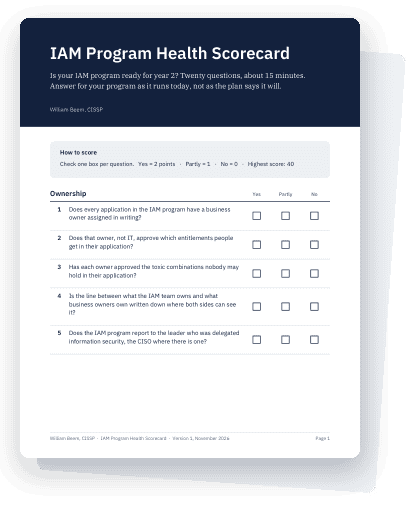
How ready is your IAM program for year 2?
Score it with the IAM Program Health Scorecard: 20 questions you can answer in about 15 minutes, as a fillable PDF sent to your inbox.
Free PDF, emailed after you confirm